
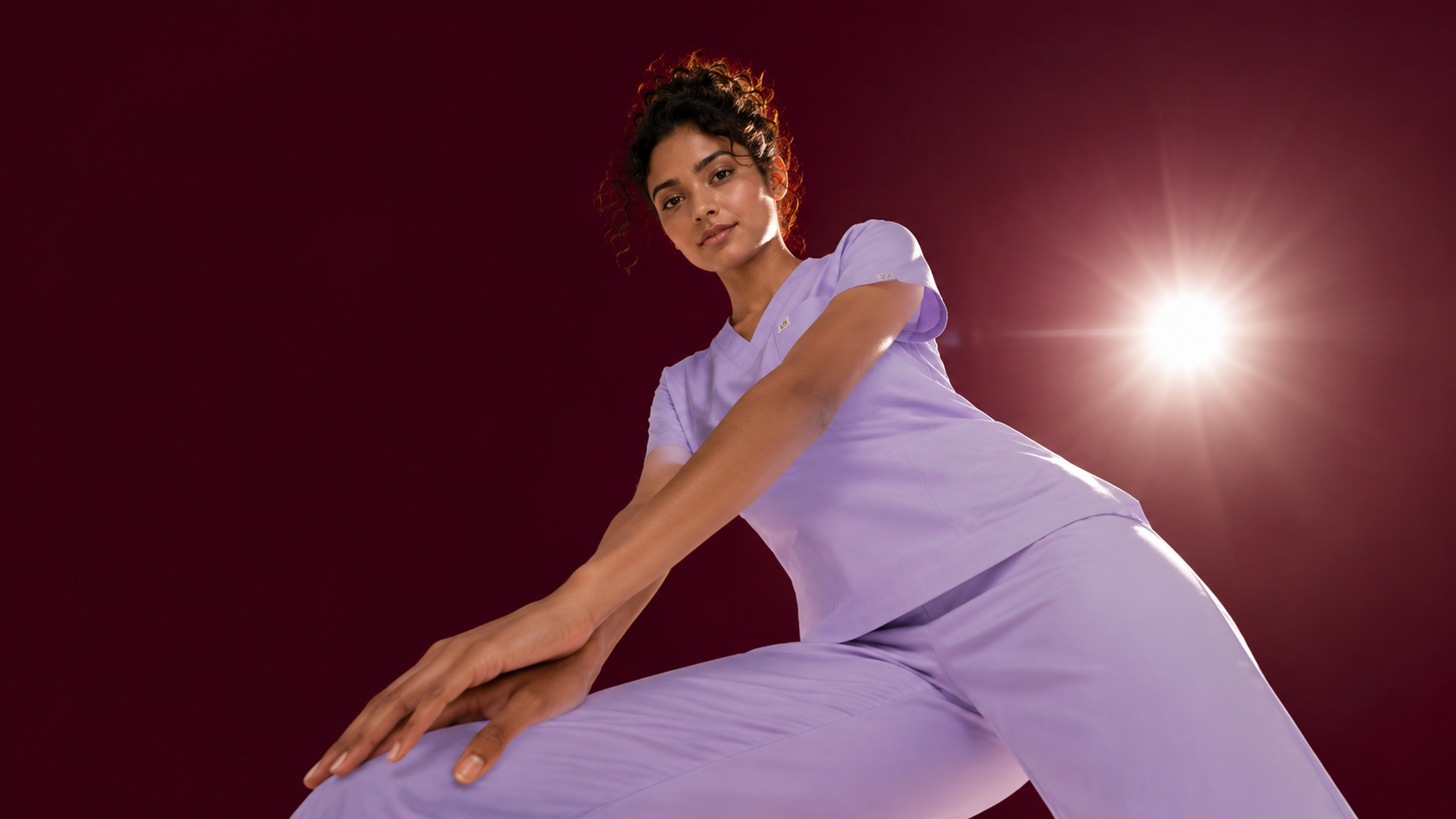
India's climate is one of the most demanding environments in the world for healthcare professionals. Whether you're doing ward rounds in Madhya Pradesh at the peak of summer, working in the humidity of coastal Gujarat, or managing back-to-back shifts in a Rajasthan district hospital — what you wear directly affects how you perform through a 12-hour shift.
Most scrub fabrics available in India were not engineered for these conditions. They trap heat, become transparent under hospital lighting, lose colour after a few washes, and wear out before the year is over. Here is what the right medical scrub fabric for Indian conditions actually looks like.
The Indian Climate Challenge for Healthcare Professionals
India spans multiple climate zones, and hospitals exist across all of them. Healthcare professionals deal with:
- Intense heat and humidity in coastal and peninsular regions — Maharashtra, Kerala, Andhra, Tamil Nadu
- Dry, extreme heat in Rajasthan and Gujarat
- Fluctuating temperatures in central India — Madhya Pradesh, Chhattisgarh, Vidarbha
- Constant in-out temperature shifts between air-conditioned wards and open corridors
What Makes a Scrub Fabric Ideal for India?
1. Moisture-Wicking
This is the most important property for Indian conditions. A fabric that actively draws moisture away from the skin and allows it to evaporate quickly keeps you dry, comfortable, and mentally focused. Standard polyester traps moisture. Quality moisture-wicking fabric moves it.
2. Breathability
Tightly woven, non-breathable fabrics turn into heat traps in Indian conditions. The best scrub fabrics balance opacity with breathability, enabling airflow close to the skin — especially critical in non-air-conditioned departments.
3. Non-Transparent Fabric
Hospital lighting in India is often bright, white, and clinical. Under direct overhead light, thin or poorly woven fabric becomes transparent — compromising professional dignity throughout the shift. Non-transparent, tightly woven fabric eliminates this problem entirely.
4. Antimicrobial Finish
Indian hospitals — particularly secondary and tertiary care institutions at high occupancy — carry higher ambient microbial load. An antimicrobial finish is not a luxury feature in this context. It is a clinical performance requirement.
5. Colourfast Performance
Frequent washing with hard water accelerates colour fade. A controlled dyeing process that maintains colour consistency through 30+ washes — and across batches for institutional orders — ensures your scrubs always look professional.
6. Soil-Release Finish
Clinical environments mean daily exposure to disinfectants, medications, blood, and general hospital contact. A soil-release finish prevents stains from penetrating deep into the fabric, making wash care easier and extending garment life.
7. Easy Care
Healthcare professionals do not have time for high-maintenance garments. A fabric that machine washes easily, dries quickly, requires minimal ironing, and returns to shape after washing fits the pace of clinical life in India.
What Care Gear Did Differently
Care Gear's FlexGO™ and FlexPRO™ fabrics were developed after 7 months of dedicated R&D — including real-world testing with medical students across Indian hospitals. The objective: build fabrics for India's healthcare setting, not adapt western scrub fabrics to a market they were never designed for.
- FlexGO™ (65% Polyester, 32% Viscose, 3% Elastane) — breathable, stretchable, moisture-wicking with antimicrobial properties. Ideal for everyday ward use, OPD, and clinical rounds.
- FlexPRO™ (72% Polyester, 21% Rayon, 7% Spandex) — exclusive 4-way stretch with enhanced moisture management and soil-release finish. Engineered for OT, emergency, and high-activity clinical roles.
What To Avoid When Buying Scrubs for Indian Conditions
| Fabric Type | Why It Fails in India |
|---|---|
| 100% Cotton | Absorbs and retains sweat heavily, takes long to dry, loses shape with frequent washing, no antimicrobial performance |
| Unblended low-quality polyester | Traps body heat, becomes transparent with wear, fades rapidly after a few washes |
| Generic uniform fabric | Not engineered for clinical environments — looks like a scrub, does not perform like one |
How to Evaluate Scrub Fabric Before Buying
- Does it carry an antimicrobial finish?
- Is the fabric moisture-wicking and breathable?
- Is it non-transparent under bright light?
- Does it stretch without losing shape?
- Will the colour stay consistent after repeated washes?
- Is the care simple enough for daily hospital laundry?
Frequently Asked Questions
What is the best fabric for medical scrubs in India?
The best scrub fabric for India combines polyester (durability, quick-dry, colour retention), viscose or rayon (breathability and softness), and elastane or spandex (stretch comfort) — with antimicrobial, moisture-wicking, and soil-release finishes.
Are cotton scrubs suitable for Indian hospitals?
Cotton feels comfortable but absorbs and retains sweat in India's heat, takes longer to dry, and loses shape with daily washing. A performance poly-viscose or poly-rayon blend significantly outperforms plain cotton for clinical use.
Are Care Gear scrubs suitable for South Indian humidity?
Yes. Both FlexGO™ and FlexPRO™ are moisture-wicking, breathable, and quick-drying — engineered specifically for extended wear in Indian climate conditions, including coastal humidity.
Why is antimicrobial fabric important in Indian hospitals?
Hospitals in India often operate at high occupancy with elevated ambient microbial load. Antimicrobial fabric inhibits bacterial and odour-causing microbe growth on the garment surface — keeping scrubs fresher and more hygienic through long clinical shifts.
How long does antimicrobial finish last on scrubs?
Quality antimicrobial finishes, when washed correctly (cold water, mild detergent, no bleach), retain efficacy for 30–50 washes or more. Following Care Gear's wash care instructions ensures the finish remains active for the full usable lifespan of the scrub.
What scrub colours work best in Indian hospitals?
Navy, maroon (Wine Berry), and Ceil Blue are widely accepted in Indian hospital settings. Charcoal and Galaxy Blue are popular for grey scrubs. Pastel Lilac and Coral Pink are commonly chosen by nursing colleges. Care Gear offers 9 colour options with consistent dye quality across all batches.
Medical scrubs that fail in Indian conditions are not just uncomfortable — they affect your focus, your appearance, and your confidence through every shift. Care Gear was built specifically so that does not happen.
Explore Care Gear Scrubs →